

Article Sidebar
Main Article Content
Abstract
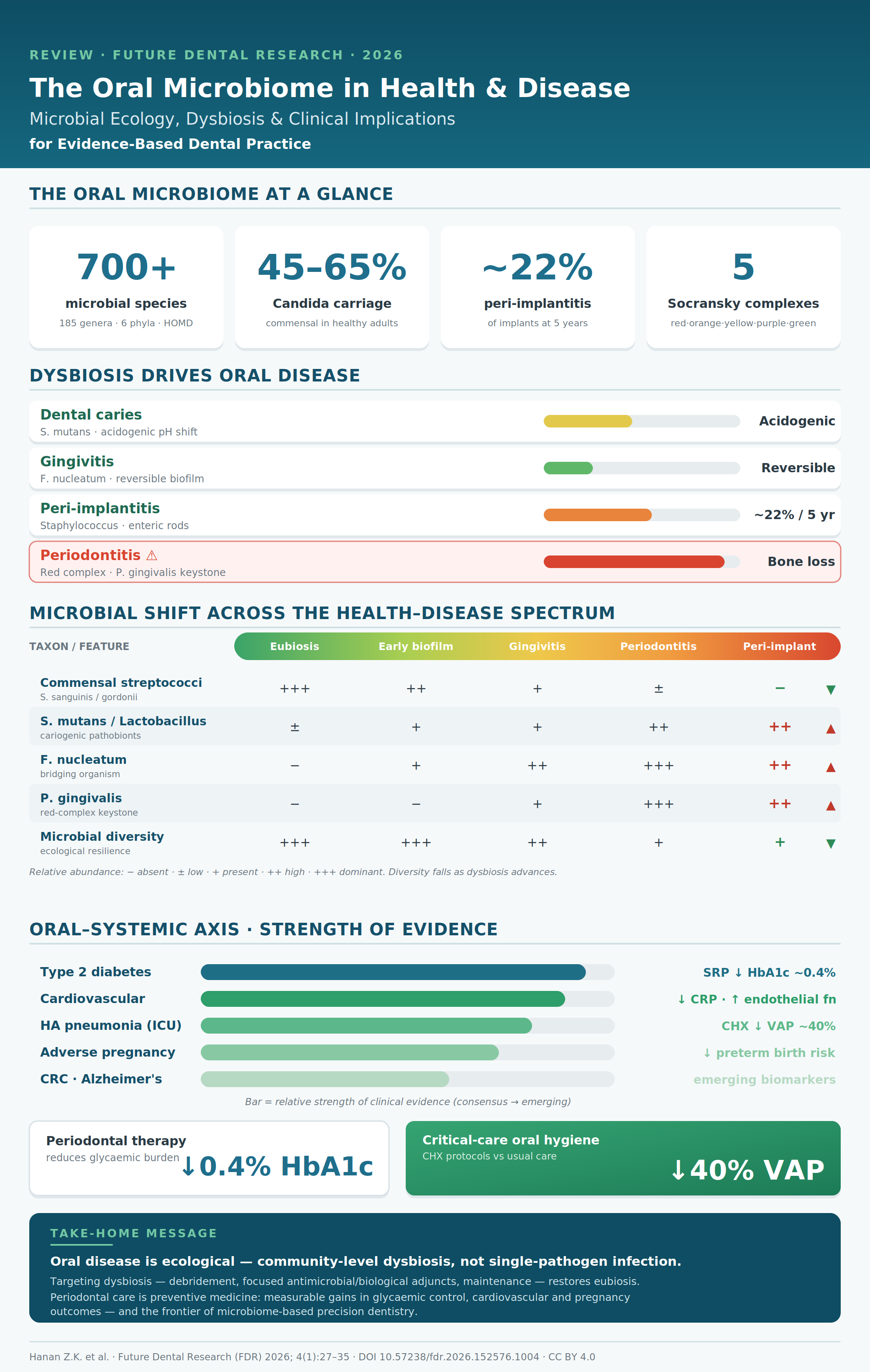
The oral cavity harbors one of the most complex microbial ecosystems in the human body, comprising more than 700 bacterial species alongside fungi, viruses, and archaea. This review provides a comprehensive examination of the composition, ecological dynamics, and clinical significance of the oral microbiome, with particular emphasis on implications for dental practice. We describe site-specific microbial communities and biofilm succession, analyze the role of keystone pathogens in driving dental caries, gingivitis, periodontitis, peri-implantitis, and oral candidiasis, and examine the Socransky periodontal complex classification system. The bidirectional oral-systemic disease axis is explored, linking periodontal dysbiosis to cardiovascular disease, type 2 diabetes, colorectal cancer, Alzheimer's disease, and adverse pregnancy outcomes. A four-step evidence-based clinical management framework integrating diagnostic risk assessment, mechanical debridement, targeted antimicrobial and biological adjuncts, and long-term preventive maintenance is presented. Microbiome-based diagnostics and emerging precision dentistry approaches are also discussed. Understanding oral microbial ecology is indispensable for contemporary, evidence-based dental practice.
Keywords
Article Details
Copyright (c) 2026 Zaman Kareem Hanan, Adnan Abed Azeez , Aliaa Kareem Hanan, Ögret. Üyesi Aysel Sari (Author)

This work is licensed under a Creative Commons Attribution 4.0 International License.
How to Cite
References
- Dewhirst FE, Chen T, Izard J, Paster BJ, Tanner AC, Yu W-H, et al. The human oral microbiome. J Bacteriol. 2010;192(19):5002-17. doi: 10.1128/jb.00542-10.
- Chen T, Yu W-H, Izard J, Baranova OV, Lakshmanan A, Dewhirst FE. The Human Oral Microbiome Database: a web accessible resource for investigating oral microbe taxonomic and genomic information. Database. 2010;2010:baq013. doi: 10.1093/database/baq013.
- Lamont RJ, Koo H, Hajishengallis G. The oral microbiota: dynamic communities and host interactions. Nat Rev Microbiol. 2018;16(12):745-59. doi: 10.1038/s41579-018-0089-x.
- Marsh PD. Dental plaque as a biofilm and a microbial community–implications for health and disease. BMC Oral Health. 2006;6:S14. doi: 0.1186/472-6831-6-S1-S14.
- Huttenhower C, Gevers D, Knight R, Abubucker S, Badger JH, Chinwalla AT, et al. Structure, function and diversity of the healthy human microbiome. Nature. 2012;486:207-14. doi: 10.1038/nature11234.
- Belda-Ferre P, Alcaraz LD, Cabrera-Rubio R, Romero H, Simon-Soro A, Pignatelli M, et al. The oral metagenome in health and disease. ISME J. 2012;6(1):46-56. doi: 10.1038/ismej.2011.85.
- Burne R, Zeng L, Ahn S, Palmer S, Liu Y, Lefebure T, et al. Progress dissecting the oral microbiome in caries and health. Adv Dent Res. 2012;24(2):77-80. doi: 10.1177/0022034512449462.
- Ghannoum MA, Jurevic RJ, Mukherjee PK, Cui F, Sikaroodi M, Naqvi A, et al. Characterization of the oral fungal microbiome (mycobiome) in healthy individuals. PLoS Pathogen. 2010;6(1):e1000713. doi: 10.1371/journal.ppat.
- Abeles SR, Pride DT. Molecular bases and role of viruses in the human microbiome. J Mol Biol. 2014;426(23):3892-906. doi: 10.1016/j.jmb.2014.07.002.
- Lepp PW, Brinig MM, Ouverney CC, Palm K, Armitage GC, Relman DA. Methanogenic Archaea and human periodontal disease. Proc NatI Acad Sci. 2004;101(16):6176-81. doi: 10.1073/pnas.0308766101.
- Kolenbrander PE, Palmer Jr RJ, Periasamy S, Jakubovics NS. Oral multispecies biofilm development and the key role of cell–cell distance. Nat Rev Microbiol. 2010;8(7):471-80. doi: 10.1038/nrmicro2381.
- Kaplan CW, Lux R, Haake SK, Shi W. The Fusobacterium nucleatum outer membrane protein RadD is an arginine‐inhibitable adhesin required for inter‐species adherence and the structured architecture of multispecies biofilm. Mol Microbiol. 2009;71(1):35-47. doi: 10.1111/j.365-2958.008.06503.x.
- Cvitkovitch DG, Li Y-H, Ellen RP. Quorum sensing and biofilm formation in Streptococcal infections. J Clin Invest. 2003;112(11):1626-32. doi: 10.172/JCI20430.
- Koo H, Falsetta M, Klein M. The exopolysaccharide matrix: a virulence determinant of cariogenic biofilm. J Dent Res. 2013;92(12):1065-73. doi: 10.177/0022034513504218.
- Takahashi N, Nyvad B. The role of bacteria in the caries process: ecological perspectives. J Dent Res. 2011;90(3):294-303. doi: 10.1177/0022034510379602.
- Nascimento MM, Browngardt C, Xiaohui X, Klepac‐Ceraj V, Paster BJ, Burne RA. The effect of arginine on oral biofilm communities. Mol Oral Microbiol. 2014;29(1):45-54. doi: 10.1111/omi.12044.
- Socransky SS, Haffajee A, Cugini M, Smith C, Kent Jr R. Microbial complexes in subgingival plaque. J Clin Periodontol. 1998;25(2):134-44. doi: 10.1111/j.600-051X.998.tb02419.x.
- Hajishengallis G, Lamont RJ. Beyond the red complex and into more complexity: the polymicrobial synergy and dysbiosis (PSD) model of periodontal disease etiology. Mol Oral Microbiol. 2012;27(6):409-19. doi: 10.1111/j.2041-1014.2012.00663.x.
- James SL, Abate D, Abate KH, Abay SM, Abbafati C, Abbasi N, et al. Global, regional, and national incidence, prevalence, and years lived with disability for 354 diseases and injuries for 195 countries and territories, 1990–2017: a systematic analysis for the Global Burden of Disease Study 2017. Lancet. 2018;392(10159):1789-858. doi: 10.016/S0140-6736(18)32279-7.
- Tanner A, Sonis A, Lif Holgerson P, Starr J, Nunez Y, Kressirer C, et al. White-spot lesions and gingivitis microbiotas in orthodontic patients. J Dent Res. 2012;91(9):853-8. doi: 10.1177/0022034512455031.
- Rakic M, Galindo-Moreno P, Monje A, Radovanovic S, Wang H-L, Cochran D, et al. How frequent does peri-implantitis occur? A systematic review and meta-analysis. Clin Oral Invest. 2018;22(4):1805-16. doi: 10.007/s00784-017-2276-y.
- Sanz M, Marco del Castillo A, Jepsen S, Gonzalez‐Juanatey JR, D’Aiuto F, Bouchard P, et al. Periodontitis and cardiovascular diseases: Consensus report. J Clin Periodontol. 2020;47(3):268-88. doi: 10.1111/jcpe.13189.
- Sanz M, Ceriello A, Buysschaert M, Chapple I, Demmer RT, Graziani F, et al. Scientific evidence on the links between periodontal diseases and diabetes: Consensus report and guidelines of the joint workshop on periodontal diseases and diabetes by the International Diabetes Federation and the European Federation of Periodontology. Diabetes Res Clin Pract. 2018;137:231-41. doi: 10.1016/j.diabres.2017.12.001.
- Castellarin M, Warren RL, Freeman JD, Dreolini L, Krzywinski M, Strauss J, et al. Fusobacterium nucleatum infection is prevalent in human colorectal carcinoma. Genome Res. 2012;22(2):299-306. doi: 10.1101/gr.126516.111.
- Dominy SS, Lynch C, Ermini F, Benedyk M, Marczyk A, Konradi A, et al. Porphyromonas gingivalis in Alzheimer’s disease brains: Evidence for disease causation and treatment with small-molecule inhibitors. Sci Adv. 2019;5(1):eaau3333. doi: 10.1126/sciadv.aau3333.
- Zhang Q, Li C, Worthington HV, Hua F. Oral hygiene care for critically ill patients to prevent ventilator‐associated pneumonia. Cochrane Database Syst Rev. 2020(12):CD008367. doi: 10.1002/14651858.CD008367.pub4.
- Dale BA, Fredericks LP. Antimicrobial peptides in the oral environment: expression and function in health and disease. Curr Issues Mol Biol. 2005;7(2):119-33. doi: 10.1093/jac/dki103.
- Quirynen M, De Soete M, Boschmans G, Pauwels M, Coucke W, Teughels W, et al. Benefit of “one‐stage full‐mouth disinfection” is explained by disinfection and root planing within 24 hours: a randomized controlled trial. J Clin Periodontol. 2006;33(9):639-47. doi: 10.1111/j.600-051X.2006.00959.x.
- Kapil V, Haydar SM, Pearl V, Lundberg JO, Weitzberg E, Ahluwalia A. Physiological role for nitrate-reducing oral bacteria in blood pressure control. Free Radic Biol Med. 2013;55:93-100. doi: 10.1016/j.freeradbiomed.2012.11.013.
- Herrera D, Matesanz P, Martín C, Oud V, Feres M, Teughels W. Adjunctive effect of locally delivered antimicrobials in periodontitis therapy: A systematic review and meta‐analysis. J Clin Periodontol. 2020;47:239-56. doi: 10.1111/jcpe.13230.
- Gruner D, Paris S, Schwendicke F. Probiotics for managing caries and periodontitis: systematic review and meta-analysis. J Dent. 2016;48:16-25. doi: 10.1016/j.jdent.2016.03.002.
- Marruganti C, Traversi J, Gaeta C, Ferrari Cagidiaco E, Parrini S, Discepoli N, et al. Adherence to Mediterranean diet, physical activity level, and severity of periodontitis: Results from a university-based cross-sectional study. J Periodontol. 2022;93:1218-32. doi: 10.1002/JPER.21-0643.
- Eckert R, He J, Yarbrough DK, Qi F, Anderson MH, Shi W. Targeted killing of Streptococcus mutans by a pheromone-guided “smart” antimicrobial peptide. Antimicrob Agents Chemother. 2006;50(11):3651-7. doi: 10.1128/aac.00622-06.
- Caporaso JG, Lauber CL, Costello EK, Berg-Lyons D, Gonzalez A, Stombaugh J, et al. Moving pictures of the human microbiome. Genome Biol. 2011;12:R50. doi: 10.1186/gb-2011-12-5-r50.
- Gomez A, Espinoza JL, Harkins DM, Leong P, Saffery R, Bockmann M, et al. Host genetic control of the oral microbiome in health and disease. Cell Host Microbe. 2017;22(3):269-78.E3. doi: 10.1016/j.chom.2017.08.013.
References
Dewhirst FE, Chen T, Izard J, Paster BJ, Tanner AC, Yu W-H, et al. The human oral microbiome. J Bacteriol. 2010;192(19):5002-17. doi: 10.1128/jb.00542-10.
Chen T, Yu W-H, Izard J, Baranova OV, Lakshmanan A, Dewhirst FE. The Human Oral Microbiome Database: a web accessible resource for investigating oral microbe taxonomic and genomic information. Database. 2010;2010:baq013. doi: 10.1093/database/baq013.
Lamont RJ, Koo H, Hajishengallis G. The oral microbiota: dynamic communities and host interactions. Nat Rev Microbiol. 2018;16(12):745-59. doi: 10.1038/s41579-018-0089-x.
Marsh PD. Dental plaque as a biofilm and a microbial community–implications for health and disease. BMC Oral Health. 2006;6:S14. doi: 0.1186/472-6831-6-S1-S14.
Huttenhower C, Gevers D, Knight R, Abubucker S, Badger JH, Chinwalla AT, et al. Structure, function and diversity of the healthy human microbiome. Nature. 2012;486:207-14. doi: 10.1038/nature11234.
Belda-Ferre P, Alcaraz LD, Cabrera-Rubio R, Romero H, Simon-Soro A, Pignatelli M, et al. The oral metagenome in health and disease. ISME J. 2012;6(1):46-56. doi: 10.1038/ismej.2011.85.
Burne R, Zeng L, Ahn S, Palmer S, Liu Y, Lefebure T, et al. Progress dissecting the oral microbiome in caries and health. Adv Dent Res. 2012;24(2):77-80. doi: 10.1177/0022034512449462.
Ghannoum MA, Jurevic RJ, Mukherjee PK, Cui F, Sikaroodi M, Naqvi A, et al. Characterization of the oral fungal microbiome (mycobiome) in healthy individuals. PLoS Pathogen. 2010;6(1):e1000713. doi: 10.1371/journal.ppat.
Abeles SR, Pride DT. Molecular bases and role of viruses in the human microbiome. J Mol Biol. 2014;426(23):3892-906. doi: 10.1016/j.jmb.2014.07.002.
Lepp PW, Brinig MM, Ouverney CC, Palm K, Armitage GC, Relman DA. Methanogenic Archaea and human periodontal disease. Proc NatI Acad Sci. 2004;101(16):6176-81. doi: 10.1073/pnas.0308766101.
Kolenbrander PE, Palmer Jr RJ, Periasamy S, Jakubovics NS. Oral multispecies biofilm development and the key role of cell–cell distance. Nat Rev Microbiol. 2010;8(7):471-80. doi: 10.1038/nrmicro2381.
Kaplan CW, Lux R, Haake SK, Shi W. The Fusobacterium nucleatum outer membrane protein RadD is an arginine‐inhibitable adhesin required for inter‐species adherence and the structured architecture of multispecies biofilm. Mol Microbiol. 2009;71(1):35-47. doi: 10.1111/j.365-2958.008.06503.x.
Cvitkovitch DG, Li Y-H, Ellen RP. Quorum sensing and biofilm formation in Streptococcal infections. J Clin Invest. 2003;112(11):1626-32. doi: 10.172/JCI20430.
Koo H, Falsetta M, Klein M. The exopolysaccharide matrix: a virulence determinant of cariogenic biofilm. J Dent Res. 2013;92(12):1065-73. doi: 10.177/0022034513504218.
Takahashi N, Nyvad B. The role of bacteria in the caries process: ecological perspectives. J Dent Res. 2011;90(3):294-303. doi: 10.1177/0022034510379602.
Nascimento MM, Browngardt C, Xiaohui X, Klepac‐Ceraj V, Paster BJ, Burne RA. The effect of arginine on oral biofilm communities. Mol Oral Microbiol. 2014;29(1):45-54. doi: 10.1111/omi.12044.
Socransky SS, Haffajee A, Cugini M, Smith C, Kent Jr R. Microbial complexes in subgingival plaque. J Clin Periodontol. 1998;25(2):134-44. doi: 10.1111/j.600-051X.998.tb02419.x.
Hajishengallis G, Lamont RJ. Beyond the red complex and into more complexity: the polymicrobial synergy and dysbiosis (PSD) model of periodontal disease etiology. Mol Oral Microbiol. 2012;27(6):409-19. doi: 10.1111/j.2041-1014.2012.00663.x.
James SL, Abate D, Abate KH, Abay SM, Abbafati C, Abbasi N, et al. Global, regional, and national incidence, prevalence, and years lived with disability for 354 diseases and injuries for 195 countries and territories, 1990–2017: a systematic analysis for the Global Burden of Disease Study 2017. Lancet. 2018;392(10159):1789-858. doi: 10.016/S0140-6736(18)32279-7.
Tanner A, Sonis A, Lif Holgerson P, Starr J, Nunez Y, Kressirer C, et al. White-spot lesions and gingivitis microbiotas in orthodontic patients. J Dent Res. 2012;91(9):853-8. doi: 10.1177/0022034512455031.
Rakic M, Galindo-Moreno P, Monje A, Radovanovic S, Wang H-L, Cochran D, et al. How frequent does peri-implantitis occur? A systematic review and meta-analysis. Clin Oral Invest. 2018;22(4):1805-16. doi: 10.007/s00784-017-2276-y.
Sanz M, Marco del Castillo A, Jepsen S, Gonzalez‐Juanatey JR, D’Aiuto F, Bouchard P, et al. Periodontitis and cardiovascular diseases: Consensus report. J Clin Periodontol. 2020;47(3):268-88. doi: 10.1111/jcpe.13189.
Sanz M, Ceriello A, Buysschaert M, Chapple I, Demmer RT, Graziani F, et al. Scientific evidence on the links between periodontal diseases and diabetes: Consensus report and guidelines of the joint workshop on periodontal diseases and diabetes by the International Diabetes Federation and the European Federation of Periodontology. Diabetes Res Clin Pract. 2018;137:231-41. doi: 10.1016/j.diabres.2017.12.001.
Castellarin M, Warren RL, Freeman JD, Dreolini L, Krzywinski M, Strauss J, et al. Fusobacterium nucleatum infection is prevalent in human colorectal carcinoma. Genome Res. 2012;22(2):299-306. doi: 10.1101/gr.126516.111.
Dominy SS, Lynch C, Ermini F, Benedyk M, Marczyk A, Konradi A, et al. Porphyromonas gingivalis in Alzheimer’s disease brains: Evidence for disease causation and treatment with small-molecule inhibitors. Sci Adv. 2019;5(1):eaau3333. doi: 10.1126/sciadv.aau3333.
Zhang Q, Li C, Worthington HV, Hua F. Oral hygiene care for critically ill patients to prevent ventilator‐associated pneumonia. Cochrane Database Syst Rev. 2020(12):CD008367. doi: 10.1002/14651858.CD008367.pub4.
Dale BA, Fredericks LP. Antimicrobial peptides in the oral environment: expression and function in health and disease. Curr Issues Mol Biol. 2005;7(2):119-33. doi: 10.1093/jac/dki103.
Quirynen M, De Soete M, Boschmans G, Pauwels M, Coucke W, Teughels W, et al. Benefit of “one‐stage full‐mouth disinfection” is explained by disinfection and root planing within 24 hours: a randomized controlled trial. J Clin Periodontol. 2006;33(9):639-47. doi: 10.1111/j.600-051X.2006.00959.x.
Kapil V, Haydar SM, Pearl V, Lundberg JO, Weitzberg E, Ahluwalia A. Physiological role for nitrate-reducing oral bacteria in blood pressure control. Free Radic Biol Med. 2013;55:93-100. doi: 10.1016/j.freeradbiomed.2012.11.013.
Herrera D, Matesanz P, Martín C, Oud V, Feres M, Teughels W. Adjunctive effect of locally delivered antimicrobials in periodontitis therapy: A systematic review and meta‐analysis. J Clin Periodontol. 2020;47:239-56. doi: 10.1111/jcpe.13230.
Gruner D, Paris S, Schwendicke F. Probiotics for managing caries and periodontitis: systematic review and meta-analysis. J Dent. 2016;48:16-25. doi: 10.1016/j.jdent.2016.03.002.
Marruganti C, Traversi J, Gaeta C, Ferrari Cagidiaco E, Parrini S, Discepoli N, et al. Adherence to Mediterranean diet, physical activity level, and severity of periodontitis: Results from a university-based cross-sectional study. J Periodontol. 2022;93:1218-32. doi: 10.1002/JPER.21-0643.
Eckert R, He J, Yarbrough DK, Qi F, Anderson MH, Shi W. Targeted killing of Streptococcus mutans by a pheromone-guided “smart” antimicrobial peptide. Antimicrob Agents Chemother. 2006;50(11):3651-7. doi: 10.1128/aac.00622-06.
Caporaso JG, Lauber CL, Costello EK, Berg-Lyons D, Gonzalez A, Stombaugh J, et al. Moving pictures of the human microbiome. Genome Biol. 2011;12:R50. doi: 10.1186/gb-2011-12-5-r50.
Gomez A, Espinoza JL, Harkins DM, Leong P, Saffery R, Bockmann M, et al. Host genetic control of the oral microbiome in health and disease. Cell Host Microbe. 2017;22(3):269-78.E3. doi: 10.1016/j.chom.2017.08.013.