

Article Sidebar
Main Article Content
Abstract
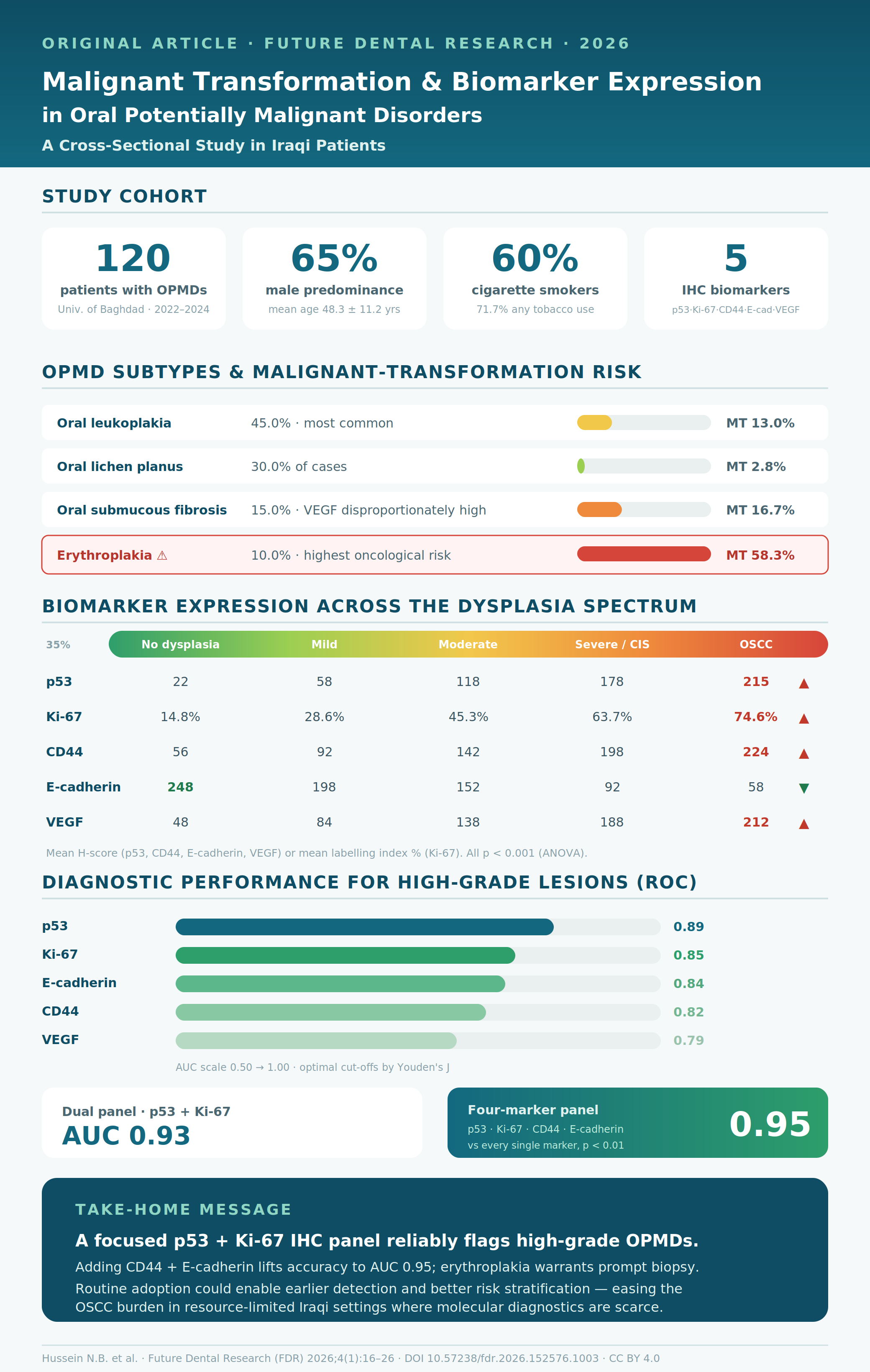
Background: Oral potentially malignant disorders (OPMDs) constitute a heterogeneous group of lesions that frequently precede the development of oral squamous cell carcinoma (OSCC). Although tobacco use remains highly prevalent among Iraqi adult males, with smoking rates approaching 38%, there is a paucity of comprehensive data regarding the clinicopathological characteristics and biomarker expression profiles of OPMDs within the Iraqi population.Objective: This study aimed to characterize the clinicopathological features of OPMDs in Iraqi patients and to evaluate the diagnostic and predictive utility of five immunohistochemical (IHC) biomarkers—p53, Ki-67, CD44, E-cadherin, and vascular endothelial growth factor (VEGF)—in identifying high-grade epithelial dysplasia and malignant transformation.Methods:A prospective cross-sectional study was conducted at the Private dental clinicsbetween, between January 2022 and December 2024, involving 120 patients diagnosed with OPMDs. Histopathological grading was performed according to the 2022 World Health Organization (WHO) classification criteria. Immunohistochemical expression of the selected biomarkers was quantified using H-score methodology. Statistical analyses, including chi-square testing, one-way analysis of variance (ANOVA), multivariable logistic regression, and receiver operating characteristic (ROC) curve analysis, were undertaken using SPSS version 26.Results: The meanpatient age was 48.3 ± 11.2 years, with a male predominance (65%). Oral leukoplakia represented the most frequently diagnosed OPMD (45%). Erythroplakia demonstrated the highest cumulative frequency of moderate-to-severe dysplasia and OSCC (83.3%). Progressive increases in p53 expression were observed across the spectrum of dysplasia, rising from 22 ± 8 in non-dysplastic lesions to 215 ± 24 in OSCC cases. Similarly, Ki-67 expression increased from 14.8% to 74.6%, whereas E-cadherin expression exhibited a marked reduction from 248 ± 18 to 58 ± 18. Among individual biomarkers, p53 demonstrated the highest discriminatory performance for identifying high-grade lesions (AUC = 0.89; 95% CI: 0.83–0.95). Furthermore, a combined four-marker panel achieved excellent diagnostic accuracy with an AUC of 0.95.Conclusions: The findings of this study indicate that a focused immunohistochemical panel incorporating p53 and Ki-67 provides robust discriminatory capacity for the identification of high-grade OPMDs in the Iraqi clinical context. The integration of these biomarkers into routine diagnostic practice may facilitate earlier detection, improve risk stratification, and support timely therapeutic intervention, thereby potentially reducing the burden of OSCC in Iraq.
Keywords
Article Details
Copyright (c) 2026 Nadhema Bahaa Hussein, Nada Khazal, Riyam Naji Ali, Zainab Mohammadi, Ismael Mohammed Alsaadi (Author)

This work is licensed under a Creative Commons Attribution 4.0 International License.
How to Cite
References
- Rumgay H, Colombet M, Ramos da Cunha A, Filho AM, Warnakulasuriya S, Conway DI, et al. Global incidence of lip, oral cavity, and pharyngeal cancers by subsite in 2022. CA Cancer J Clin. 2026;76(1):1-13. doi: 0.3322/caac.70048.
- Alshami ML, Al‐Maliky MA, Alsagban AA, Alshaeli AJ. Epidemiology and incidence of oral squamous cell carcinoma in the Iraqi population over 5 years (2014–2018). Health Sci Rep. 2023;6(4):e1205. doi: 10.002/hsr2.
- Warnakulasuriya S, Kujan O, Aguirre‐Urizar JM, Bagan JV, González‐Moles MÁ, Kerr AR, et al. Oral potentially malignant disorders: A consensus report from an international seminar on nomenclature and classification, convened by the WHO Collaborating Centre for Oral Cancer. Oral Dis. 2021;27(8):1862-80. doi: 10.111/odi.13704.
- Muller S, Tilakaratne WM. Update from the 5th edition of the World Health Organization classification of head and neck tumors: tumours of the oral cavity and mobile tongue. Head Neck Pathol. 2022;16:54-62. doi: 10.1007/s12105-021-01402-9.
- Odell E, Kujan O, Warnakulasuriya S, Sloan P. Oral epithelial dysplasia: recognition, grading and clinical significance. Oral Dis. 2021;27(8):1947-76. doi: 10.111/odi.13993.
- Hankinson P, Clark M, Walsh H, Khurram SA. A head‐to‐head comparison of four grading systems for oral epithelial dysplasia. Histopathology. 2025;86(6):933-41. doi: 10.1111/his.15400.
- Aguirre‐Urizar JM, Lafuente‐Ibáñez de Mendoza I, Warnakulasuriya S. Malignant transformation of oral leukoplakia: Systematic review and meta‐analysis of the last 5 years. Oral Dis. 2021;27(8):1881-95. doi: 10.111/odi.13810.
- González-Moles MÁ, Ramos-Garcia P. An evidence-based update on the potential for malignancy of oral lichen planus and related conditions: a systematic review and meta-analysis. Cancers. 2024;16(3):608. doi: 10.3390/cancers16030608.
- Murthy V, Mylonas P, Carey B, Yogarajah S, Farnell D, Addison O, et al. Malignant transformation rate of oral submucous fibrosis: a systematic review and meta-analysis. J Clin Med. 2022;11(7):1793. doi: 10.3390/jcm11071793.
- Lorenzo‐Pouso AI, Lafuente‐Ibáñez de Mendoza I, Pérez‐Sayáns M, Pérez‐Jardón A, Chamorro‐Petronacci CM, Blanco‐Carrión A, et al. Critical update, systematic review, and meta‐analysis of oral erythroplakia as an oral potentially malignant disorder. J Oral Pathol Med. 2022;51(7):585-93. doi: 10.1111/jop.13304.
- Fuoad SAA, Mohammad DN, Hamied MA-S, Garib BT. Oro-facial malignancy in north of Iraq: a retrospective study of biopsied cases. BMC Oral Health. 2021;21:147. doi: 10.1186/s12903-021-01521-3.
- Mello FW, Melo G, Guerra ENS, Warnakulasuriya S, Garnis C, Rivero ERC. Oral potentially malignant disorders: a scoping review of prognostic biomarkers. Crit Rev Oncol/Hematol. 2020;153:102986. doi: 10.1016/j.critrevonc.2020.
- Monteiro L, Mello FW, Warnakulasuriya S. Tissue biomarkers for predicting the risk of oral cancer in patients diagnosed with oral leukoplakia: A systematic review. Oral Dis. 2021;27(8):1977-92. doi: 10.111/odi.13747.
- Turton N, Payne K, Higginson J, Praveen P, Mehanna H, Nankivell P. Prognostic biomarkers for malignant progression of oral epithelial dysplasia: an updated systematic review and meta-analysis. Br J Oral Maxillofac Surg. 2024;62(5):415-25. doi: 10.1016/j.bjoms.2024.03.001.
- Sawada K, Momose S, Kawano R, Kohda M, Irié T, Mishima K, et al. Immunohistochemical staining patterns of p53 predict the mutational status of TP53 in oral epithelial dysplasia. Mod Pathol. 2022;35(2):177-85. doi: 10.1038/s41379-021-00893-9.
- Ko YCK, Liu KYP, Chen E, Zhu SY, Poh CF. P53 abnormal oral epithelial dysplasias are associated with high risks of progression and local recurrence—a retrospective study in a longitudinal cohort. Mod Pathol. 2024;37(12):100613. doi: 10.1016/j.modpat.2024.
- Bahramian A, Motahari P, Hanifenezhad A. Expression of Ki-67 in oral lichen planus: a systematic review and meta-analysis. J Dent. 2024;25(4):288-95. doi: 10.30476/dentjods.2023.98491.2082.
- Hassn Mesrati M, Syafruddin SE, Mohtar MA, Syahir A. CD44: a multifunctional mediator of cancer progression. Biomolecules. 2021;11(12):1850. doi: 10.3390/biom11121850.
- Hakim SG, Taubitz C, Hoppe S, Steller D, Rades D, Ribbat-Idel J, et al. Prognostic impact of the loss of E-cadherin and de novo expression of N-cadherin at the invasive front of primary and recurrent oral squamous cell carcinoma. Front Oncol. 2023;13:1151879. doi: 10.3389/fonc.2023.
- Yim IS, Laronde DM. Biomarkers of epithelial–mesenchymal transition: E-cadherin and beta-catenin in malignant transformation of oral lesions. Can J Dent Hyg. 2024;58(2):111-9.
- Choudhari S, Kulkarni D, Patankar S, Kheur S, Sarode S. Linking inflammation and angiogenesis with fibrogenesis: Expression of FXIIIA, MMP-9, and VEGF in oral submucous fibrosis. Esp J Pathol. 2024;57(1):15-26. doi: 10.1016/j.patol.2023.11.005.
- Al-Badri HJA, Khaleefah Ali MA, Ali AA, Sahib AJ. Socio-economic determinants of smoking among Iraqi adults: Data from Non-Communicable Risk Factor STEPS survey 2015. PLoS One. 2017;12(9):e0184989. doi: 10.1371/journal.pone.
- Rassol HJ, Zaidan TF. Immunohistochemical expression of T-cell subsets (CD4 and CD8) in oral lichen planus. Pan Afr Med J. 2023;45:147. doi: 10.11604/pamj.2023.45.147.38629.
- Mohsin SF, Al-Drobie B. Human papillomavirus expression in relation to biological behavior, Ki-67 proliferative marker, and P53 prognostic marker in Schneiderian papilloma. J Med Life. 2023;16(7):1022-7. doi: 10.25122/jml-2022-0312.
- Warnakulasuriya S. Oral potentially malignant disorders: A comprehensive review on clinical aspects and management. Oral Oncol. 2020;102:104550. doi: 10.1016/j.oraloncology.2019.
- Gupta V, Ramalingam K, Yasothkumar D, Debnath D, Sundar V. Ki-67 Expression as a Prognostic Marker: A Comparative Immunohistochemical Analysis of Oral Epithelial Dysplasia and Oral Squamous Cell Carcinoma. Cureus. 2023;15(5):e38941. doi: 10.7759/cureus.
- Singh M, Agrawal P, Sharma E, Yadav JS, Sethi C, Sharma N. Expression of CD44 and Its Correlation with Clinicopathological Factors in Oral and Oropharyngeal Carcinoma: A Retrospective Immunohistochemical Study. Cureus. 2025;17(3):e81274. doi: 10.7759/cureus.
- de Morais EF, Pinheiro JC, Lira JAS, Mafra RP, Barboza CAG, de Souza LB, et al. Prognostic value of the immunohistochemical detection of epithelial-mesenchymal transition biomarkers in oral epithelial dysplasia: A systematic review. Med Oral Patol Oral Cir Bucal. 2020;25(2):e205-e16. doi: 10.4317/medoral.23305.
- Mahmood H, Bradburn M, Rajpoot N, Islam NM, Kujan O, Khurram SA. Prediction of malignant transformation and recurrence of oral epithelial dysplasia using architectural and cytological feature specific prognostic models. Mod Pathol. 2022;35(9):1151-9. doi: 10.038/s41379-022-01067-x.
- Novack R, Zhang L, Hoang LN, Kadhim M, Ng TL, Poh CF, et al. Abnormal p53 immunohistochemical patterns shed light on the aggressiveness of oral epithelial dysplasia. Mod Pathol. 2023;36(7):100153. doi: 10.1016/j.modpat.2023.
- Trivedi TI, Mandaliya TH, Trivedi PP. Protein expression of cancer stem cell markers ABCG2, podoplanin, and CD44 predicts early recurrence of oral squamous cell carcinoma: A study from Western India. Indian J Pathol Microbiol. 2025;68(2):287-93. doi: 10.4103/ijpm.ijpm_479_24.
- Kadeh H, Parsamanesh N, Miri‐Moghaddam E. Effect of CDH1 and CDH2 genes polymorphisms in oral squamous cell carcinoma susceptibility in a sample of Iranian population: A case‐control study. Health Sci Rep. 2023;6(4):e1221. doi: 10.002/hsr2.
- Qin X, Ning Y, Zhou L, Zhu Y. Oral submucous fibrosis: etiological mechanism, malignant transformation, therapeutic approaches and targets. Int J Mol Sci. 2023;24(5):4992. doi: 10.3390/ijms24054992.
- Ghazaghi F, Saffar H, Yazdani F, Etebarian A. Clinical significance and prognostic value of SOX2 protein expression in patients with oral squamous cell carcinoma. Appl Immunohistochem Mol Morphol. 2021;29(9):700-5. doi: 10.1097/PAI.0000000000000942.
- Lau J, Guru O, Warnakulasuriya S, Balasubramaniam R, Frydrych A, Kujan O. Adjunctive aids for the detection of oral squamous cell carcinoma and oral potentially malignant disorders: A systematic review of systematic reviews. Jpn Dent Sci Rev. 2024;60:53-72. doi: 10.1016/j.jdsr.2023.12.004.
- Bhattarai B, Singh A, Singh R, Chaulagain R, Søland T, Hasséus B, et al. Recurrence in oral leukoplakia: a systematic review and meta-analysis. J Dent Res. 2024;103(11):1066-75. doi: 10.177/00220345241266519.
- Kerr AR, Lodi G. Management of oral potentially malignant disorders. Oral Dis. 2021;27(8):2008-25. doi: 10.1111/odi.13980.
- Walsh T, Warnakulasuriya S, Lingen MW, Kerr AR, Ogden GR, Glenny A-M, et al. Clinical assessment for the detection of oral cavity cancer and potentially malignant disorders in apparently healthy adults. Cochrane Database Syst Rev. 2021(12):CD010173. doi: 10.1002/14651858.CD010173.pub3.
References
Rumgay H, Colombet M, Ramos da Cunha A, Filho AM, Warnakulasuriya S, Conway DI, et al. Global incidence of lip, oral cavity, and pharyngeal cancers by subsite in 2022. CA Cancer J Clin. 2026;76(1):1-13. doi: 0.3322/caac.70048.
Alshami ML, Al‐Maliky MA, Alsagban AA, Alshaeli AJ. Epidemiology and incidence of oral squamous cell carcinoma in the Iraqi population over 5 years (2014–2018). Health Sci Rep. 2023;6(4):e1205. doi: 10.002/hsr2.
Warnakulasuriya S, Kujan O, Aguirre‐Urizar JM, Bagan JV, González‐Moles MÁ, Kerr AR, et al. Oral potentially malignant disorders: A consensus report from an international seminar on nomenclature and classification, convened by the WHO Collaborating Centre for Oral Cancer. Oral Dis. 2021;27(8):1862-80. doi: 10.111/odi.13704.
Muller S, Tilakaratne WM. Update from the 5th edition of the World Health Organization classification of head and neck tumors: tumours of the oral cavity and mobile tongue. Head Neck Pathol. 2022;16:54-62. doi: 10.1007/s12105-021-01402-9.
Odell E, Kujan O, Warnakulasuriya S, Sloan P. Oral epithelial dysplasia: recognition, grading and clinical significance. Oral Dis. 2021;27(8):1947-76. doi: 10.111/odi.13993.
Hankinson P, Clark M, Walsh H, Khurram SA. A head‐to‐head comparison of four grading systems for oral epithelial dysplasia. Histopathology. 2025;86(6):933-41. doi: 10.1111/his.15400.
Aguirre‐Urizar JM, Lafuente‐Ibáñez de Mendoza I, Warnakulasuriya S. Malignant transformation of oral leukoplakia: Systematic review and meta‐analysis of the last 5 years. Oral Dis. 2021;27(8):1881-95. doi: 10.111/odi.13810.
González-Moles MÁ, Ramos-Garcia P. An evidence-based update on the potential for malignancy of oral lichen planus and related conditions: a systematic review and meta-analysis. Cancers. 2024;16(3):608. doi: 10.3390/cancers16030608.
Murthy V, Mylonas P, Carey B, Yogarajah S, Farnell D, Addison O, et al. Malignant transformation rate of oral submucous fibrosis: a systematic review and meta-analysis. J Clin Med. 2022;11(7):1793. doi: 10.3390/jcm11071793.
Lorenzo‐Pouso AI, Lafuente‐Ibáñez de Mendoza I, Pérez‐Sayáns M, Pérez‐Jardón A, Chamorro‐Petronacci CM, Blanco‐Carrión A, et al. Critical update, systematic review, and meta‐analysis of oral erythroplakia as an oral potentially malignant disorder. J Oral Pathol Med. 2022;51(7):585-93. doi: 10.1111/jop.13304.
Fuoad SAA, Mohammad DN, Hamied MA-S, Garib BT. Oro-facial malignancy in north of Iraq: a retrospective study of biopsied cases. BMC Oral Health. 2021;21:147. doi: 10.1186/s12903-021-01521-3.
Mello FW, Melo G, Guerra ENS, Warnakulasuriya S, Garnis C, Rivero ERC. Oral potentially malignant disorders: a scoping review of prognostic biomarkers. Crit Rev Oncol/Hematol. 2020;153:102986. doi: 10.1016/j.critrevonc.2020.
Monteiro L, Mello FW, Warnakulasuriya S. Tissue biomarkers for predicting the risk of oral cancer in patients diagnosed with oral leukoplakia: A systematic review. Oral Dis. 2021;27(8):1977-92. doi: 10.111/odi.13747.
Turton N, Payne K, Higginson J, Praveen P, Mehanna H, Nankivell P. Prognostic biomarkers for malignant progression of oral epithelial dysplasia: an updated systematic review and meta-analysis. Br J Oral Maxillofac Surg. 2024;62(5):415-25. doi: 10.1016/j.bjoms.2024.03.001.
Sawada K, Momose S, Kawano R, Kohda M, Irié T, Mishima K, et al. Immunohistochemical staining patterns of p53 predict the mutational status of TP53 in oral epithelial dysplasia. Mod Pathol. 2022;35(2):177-85. doi: 10.1038/s41379-021-00893-9.
Ko YCK, Liu KYP, Chen E, Zhu SY, Poh CF. P53 abnormal oral epithelial dysplasias are associated with high risks of progression and local recurrence—a retrospective study in a longitudinal cohort. Mod Pathol. 2024;37(12):100613. doi: 10.1016/j.modpat.2024.
Bahramian A, Motahari P, Hanifenezhad A. Expression of Ki-67 in oral lichen planus: a systematic review and meta-analysis. J Dent. 2024;25(4):288-95. doi: 10.30476/dentjods.2023.98491.2082.
Hassn Mesrati M, Syafruddin SE, Mohtar MA, Syahir A. CD44: a multifunctional mediator of cancer progression. Biomolecules. 2021;11(12):1850. doi: 10.3390/biom11121850.
Hakim SG, Taubitz C, Hoppe S, Steller D, Rades D, Ribbat-Idel J, et al. Prognostic impact of the loss of E-cadherin and de novo expression of N-cadherin at the invasive front of primary and recurrent oral squamous cell carcinoma. Front Oncol. 2023;13:1151879. doi: 10.3389/fonc.2023.
Yim IS, Laronde DM. Biomarkers of epithelial–mesenchymal transition: E-cadherin and beta-catenin in malignant transformation of oral lesions. Can J Dent Hyg. 2024;58(2):111-9.
Choudhari S, Kulkarni D, Patankar S, Kheur S, Sarode S. Linking inflammation and angiogenesis with fibrogenesis: Expression of FXIIIA, MMP-9, and VEGF in oral submucous fibrosis. Esp J Pathol. 2024;57(1):15-26. doi: 10.1016/j.patol.2023.11.005.
Al-Badri HJA, Khaleefah Ali MA, Ali AA, Sahib AJ. Socio-economic determinants of smoking among Iraqi adults: Data from Non-Communicable Risk Factor STEPS survey 2015. PLoS One. 2017;12(9):e0184989. doi: 10.1371/journal.pone.
Rassol HJ, Zaidan TF. Immunohistochemical expression of T-cell subsets (CD4 and CD8) in oral lichen planus. Pan Afr Med J. 2023;45:147. doi: 10.11604/pamj.2023.45.147.38629.
Mohsin SF, Al-Drobie B. Human papillomavirus expression in relation to biological behavior, Ki-67 proliferative marker, and P53 prognostic marker in Schneiderian papilloma. J Med Life. 2023;16(7):1022-7. doi: 10.25122/jml-2022-0312.
Warnakulasuriya S. Oral potentially malignant disorders: A comprehensive review on clinical aspects and management. Oral Oncol. 2020;102:104550. doi: 10.1016/j.oraloncology.2019.
Gupta V, Ramalingam K, Yasothkumar D, Debnath D, Sundar V. Ki-67 Expression as a Prognostic Marker: A Comparative Immunohistochemical Analysis of Oral Epithelial Dysplasia and Oral Squamous Cell Carcinoma. Cureus. 2023;15(5):e38941. doi: 10.7759/cureus.
Singh M, Agrawal P, Sharma E, Yadav JS, Sethi C, Sharma N. Expression of CD44 and Its Correlation with Clinicopathological Factors in Oral and Oropharyngeal Carcinoma: A Retrospective Immunohistochemical Study. Cureus. 2025;17(3):e81274. doi: 10.7759/cureus.
de Morais EF, Pinheiro JC, Lira JAS, Mafra RP, Barboza CAG, de Souza LB, et al. Prognostic value of the immunohistochemical detection of epithelial-mesenchymal transition biomarkers in oral epithelial dysplasia: A systematic review. Med Oral Patol Oral Cir Bucal. 2020;25(2):e205-e16. doi: 10.4317/medoral.23305.
Mahmood H, Bradburn M, Rajpoot N, Islam NM, Kujan O, Khurram SA. Prediction of malignant transformation and recurrence of oral epithelial dysplasia using architectural and cytological feature specific prognostic models. Mod Pathol. 2022;35(9):1151-9. doi: 10.038/s41379-022-01067-x.
Novack R, Zhang L, Hoang LN, Kadhim M, Ng TL, Poh CF, et al. Abnormal p53 immunohistochemical patterns shed light on the aggressiveness of oral epithelial dysplasia. Mod Pathol. 2023;36(7):100153. doi: 10.1016/j.modpat.2023.
Trivedi TI, Mandaliya TH, Trivedi PP. Protein expression of cancer stem cell markers ABCG2, podoplanin, and CD44 predicts early recurrence of oral squamous cell carcinoma: A study from Western India. Indian J Pathol Microbiol. 2025;68(2):287-93. doi: 10.4103/ijpm.ijpm_479_24.
Kadeh H, Parsamanesh N, Miri‐Moghaddam E. Effect of CDH1 and CDH2 genes polymorphisms in oral squamous cell carcinoma susceptibility in a sample of Iranian population: A case‐control study. Health Sci Rep. 2023;6(4):e1221. doi: 10.002/hsr2.
Qin X, Ning Y, Zhou L, Zhu Y. Oral submucous fibrosis: etiological mechanism, malignant transformation, therapeutic approaches and targets. Int J Mol Sci. 2023;24(5):4992. doi: 10.3390/ijms24054992.
Ghazaghi F, Saffar H, Yazdani F, Etebarian A. Clinical significance and prognostic value of SOX2 protein expression in patients with oral squamous cell carcinoma. Appl Immunohistochem Mol Morphol. 2021;29(9):700-5. doi: 10.1097/PAI.0000000000000942.
Lau J, Guru O, Warnakulasuriya S, Balasubramaniam R, Frydrych A, Kujan O. Adjunctive aids for the detection of oral squamous cell carcinoma and oral potentially malignant disorders: A systematic review of systematic reviews. Jpn Dent Sci Rev. 2024;60:53-72. doi: 10.1016/j.jdsr.2023.12.004.
Bhattarai B, Singh A, Singh R, Chaulagain R, Søland T, Hasséus B, et al. Recurrence in oral leukoplakia: a systematic review and meta-analysis. J Dent Res. 2024;103(11):1066-75. doi: 10.177/00220345241266519.
Kerr AR, Lodi G. Management of oral potentially malignant disorders. Oral Dis. 2021;27(8):2008-25. doi: 10.1111/odi.13980.
Walsh T, Warnakulasuriya S, Lingen MW, Kerr AR, Ogden GR, Glenny A-M, et al. Clinical assessment for the detection of oral cavity cancer and potentially malignant disorders in apparently healthy adults. Cochrane Database Syst Rev. 2021(12):CD010173. doi: 10.1002/14651858.CD010173.pub3.